
Wall Street Bounces Back, but the Fed's Shadow Hasn't Lifted
Date: 2026-06-18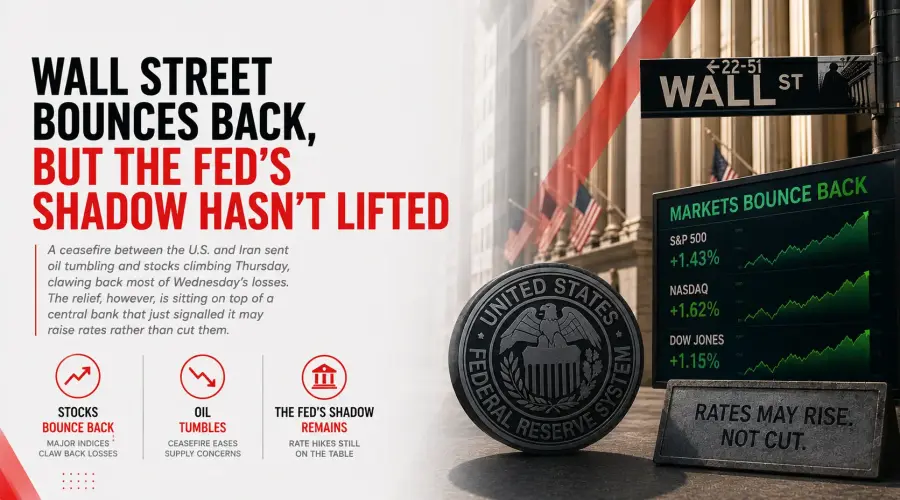
Wall Street Bounces Back, but the Fed's Shadow Hasn't Lifted
A ceasefire between the U.S. and Iran sent oil tumbling and stocks climbing Thursday, clawing back most of Wednesday's losses. The relief, however, is sitting on top of a central bank that just signalled it may raise rates rather than cut them.
Key Points
- The S&P 500 rose 0.8%, the Dow gained 242 points (0.5%), and the Nasdaq climbed 0.8% Thursday morning, putting every major index on track for weekly gains.
- Brent crude fell 3.1% to $77.11 a barrel after the U.S. and Iran signed an agreement ending their war and reopening the Strait of Hormuz, through which a fifth of the world's oil supply passes.
- The Federal Reserve held its benchmark rate steady Wednesday but signalled it will likely raise rates at least once by December — a reversal from its prior easing path, driven by inflation pressures tied to elevated energy and shipping costs.
- Intel surged 7.4% after President Trump announced the chipmaker will manufacture semiconductors for Apple in the U.S.; SpaceX fell 6.5%, extending losses into its second day of trading after a high-profile market debut.
Markets have a way of treating geopolitical resolution and central bank hawkishness as two entirely separate stories, even when they are tangled up in the same trading session. On Thursday, Wall Street chose to focus on the first. Stocks climbed broadly, recovering most of what they had lost a day earlier, as a diplomatic breakthrough between the United States and Iran sent oil prices sharply lower and eased one of the more acute sources of market anxiety in recent weeks.
The S&P 500 gained 0.8 per cent. The Dow Jones Industrial Average added 242 points, also roughly 0.8 per cent in percentage terms, while the Nasdaq composite rose by the same 0.8 per cent as the S&P. Every major U.S. index entered Thursday on pace to close out the week with gains — a notable feat given how turbulent the preceding days had been. American markets are closed Friday for the Juneteenth holiday, giving the week's rally an early finish line.
"Higher oil prices had been weighing on markets throughout the U.S. war with Iran."
— The Associated Press, June 18, 2026The catalyst for Thursday's relief rally was unambiguous. The United States and Iran signed an agreement ending their conflict and reopening the Strait of Hormuz to oil tanker traffic — a chokepoint through which roughly a fifth of the world's crude oil supply moves. Brent crude, the international benchmark, fell 3.1 per cent to $77.11 a barrel. U.S. benchmark crude dropped 3.7 per cent to $73.15. Both figures remain comfortably above the roughly $70 level that prevailed before the conflict began, but they are well off the triple-digit prices oil had reached just weeks earlier at the height of hostilities. The new agreement also lifts sanctions on Iran and allows the country to sell its oil on the open market, adding supply that traders are already pricing in.
That oil relief matters because it intersects directly with the inflation story that has been reshaping Federal Reserve policy. The average U.S. gasoline price has slipped below $4 a gallon, though it remains roughly 25 per cent higher than a year earlier, and elevated shipping costs have pushed prices higher across a wide range of consumer goods. That combination of pressures led the Fed, at the conclusion of its two-day policy meeting on Wednesday, to hold its benchmark interest rate steady while signalling that it now expects to raise rates at least once before the end of the year — a sharp reversal from the rate-cutting path markets had been pricing in for much of the past year.
The hawkish signal initially rattled bond markets on Wednesday, pushing yields higher and stocks lower. By Thursday, though, yields were easing back. The 10-year Treasury yield fell to 4.44 per cent from 4.49 per cent the previous session, while the 2-year yield — which tends to track Fed policy expectations more closely — dropped to 4.16 per cent from 4.20 per cent. The combination of falling yields and falling oil prices gave equities the room to recover.
The rally was led by technology and semiconductor names. Intel jumped 7.4 per cent after President Donald Trump announced that the company would manufacture chips for Apple within the United States — a deal with clear implications for the reshoring of advanced chip production. Other major semiconductor firms moved higher in sympathy: Nvidia rose 1.5 per cent and Micron Technology surged 6.1 per cent. Not every high-profile name participated in the recovery, however. SpaceX extended its post-listing slide for a second consecutive day, falling 6.5 per cent after a 4.9 per cent decline on Wednesday, a rocky start for the Elon Musk-led company following its closely watched debut on U.S. public markets last week.
Markets in Europe and Asia closed the day mixed, a reminder that the optimism driving Wall Street's bounce was not uniformly shared across global exchanges. For U.S. investors, the week's takeaway is a familiar one dressed in new circumstances: geopolitical risk can resolve quickly and decisively, while the inflation dynamics it leaves behind tend to linger considerably longer. The Strait of Hormuz may be open again, but the Federal Reserve's pivot toward higher rates is the story markets will be living with well past this news cycle.