
Vancouver's Bitcoin Ambition Hits a Legal Wall
Date: 2026-06-06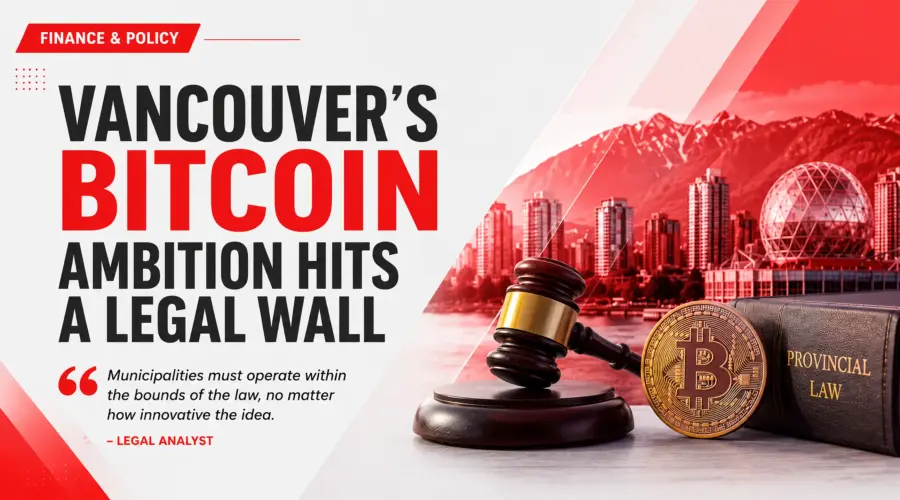
Vancouver's Bitcoin Ambition Hits a Legal Wall
Mayor Ken Sim's bold push to put city reserves into bitcoin was always going to be a fight. It turns out the fight was already over before it began.
Key Points
- Vancouver's staff report concludes bitcoin is not a legally permitted reserve asset under the Vancouver Charter.
- Provincial law reinforces the restriction, limiting city funds to government securities, bank instruments, and similar conservative assets.
- The door remains slightly ajar: the city could still accept bitcoin as payment, provided funds are converted immediately to Canadian dollars.
It was the kind of headline that made crypto enthusiasts sit up and take notice. In December 2024, Vancouver's city council passed a motion declaring the city officially "bitcoin-friendly," with Mayor Ken Sim championing the idea of investing municipal reserves in the world's largest cryptocurrency. The ambition was real. The legal scaffolding to support it, apparently, was not.
A staff report released ahead of the city's March 2026 council meeting has effectively put the brakes on that vision — not through political disagreement, but through a straightforward reading of existing law. Staff concluded, without ambiguity, that bitcoin does not qualify as an allowable investment asset under the Vancouver Charter. The 2024 motion, it recommends, should be formally closed.
"Conclusively determined that under the Vancouver Charter, bitcoin is not an allowable investment asset for the City."
— City of Vancouver Staff Report, March 2026The issue lies in how tightly Canadian municipal investment rules are drawn. Section 201 of the Vancouver Charter restricts how the city can deploy idle public funds, permitting only a narrow set of instruments: federal and provincial government securities, government-guaranteed bonds, municipal debt, bank-backed investments, credit union deposits, and certain approved pooled investment vehicles. The framework reflects the conservative posture that governments have long taken toward public money — one built on capital preservation rather than speculative upside.
British Columbia's Municipal Finance Authority Act reinforces this conservatism from the provincial level. Investment pools under that legislation are confined to government bonds, municipal securities, bank deposits, and highly rated commercial paper. Eligible securities are defined as bonds, debentures, deposit certificates, and promissory notes — all fixtures of the fixed-income world. Equities don't make the cut. Neither do commodities. Cryptocurrencies aren't mentioned at all, and their absence is, legally speaking, as definitive as an explicit prohibition.
Supporters of the proposal may find cold comfort in the argument that Vancouver could still gesture toward a bitcoin-friendly identity through a more modest route. The staff report leaves open the possibility that the city could accept bitcoin as payment for taxes or fees — not as an asset it holds, but as a currency it immediately converts into Canadian dollars. The Vancouver Charter governs investment of public funds; it doesn't necessarily dictate how payments are processed before they become city funds. That nuance may be the only live thread remaining from Sim's original vision.
The episode offers a useful window into the friction between the political enthusiasm for cryptocurrency adoption and the slow-moving machinery of public finance law. Mayors can make motions and signal intent, but municipal treasuries operate inside legal frameworks that were designed decades before Satoshi Nakamoto published his white paper. Updating those frameworks to permit bitcoin holdings would require provincial legislative action — a heavier lift than any city hall vote.
For now, Vancouver's reserves will remain where the charter has always required them to be: in instruments that earn modest returns and carry no weekend volatility. Whether that represents prudent stewardship or a missed opportunity depends entirely on who you ask.