

The World Cup Is Days Away. Canada's Hotel Rooms Are Half Empty
Date: 2026-06-10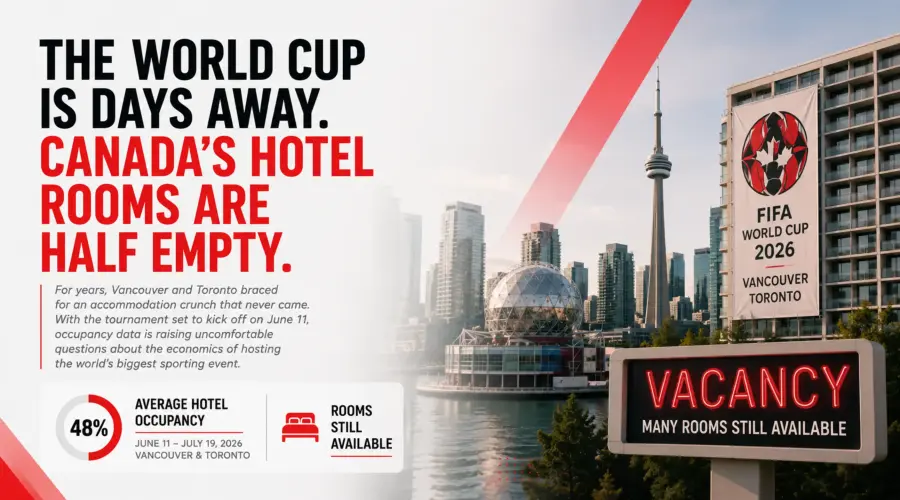
The World Cup Is Days Away. Canada's Hotel Rooms Are Half Empty.
For years, Vancouver and Toronto braced for an accommodation crunch that never came. With the tournament set to kick off on June 11, occupancy data is raising uncomfortable questions about the economics of hosting the world's biggest sporting event.
Key Points
- CoStar data shows Vancouver hotel occupancy sitting at just under 48% on World Cup game days — down more than 25% from the same period last year, when the city was 64.5% booked.
- Toronto is tracking just above 47% occupancy, making both Canadian cities among the leaders across all 16 host cities, but still far below the boom that was widely predicted.
- Vancouver Airbnb host Noah Reitman lowered his prices after discovering most guests were booking for ordinary tourism — unaware the World Cup was even happening in the city.
- Concordia University sports economist Moshe Lander attributes the drop in occupancy to "economic destruction" — a displacement of regular visitors not accounted for in standard FIFA economic impact projections.
A few years ago, Vancouver's tourism industry was sounding the alarm. Reports commissioned by Airbnb projected a shortage of 70,000 room-nights. City councillors passed motions to ease zoning restrictions and encourage hotel development. Industry groups warned that the city simply would not have enough beds for the hundreds of thousands of fans expected to descend on the coast for the FIFA World Cup. That conversation seems, in retrospect, to have been about a different tournament than the one that is actually arriving.
With matches in Canada set to begin on June 11, new data from hotel analytics firm CoStar is telling a starkly different story. Vancouver's hotel occupancy on World Cup game days currently sits at just under 48 per cent — a drop of more than 25 percentage points from June 2025, when the city's hotels were running at 64.5 per cent full. Toronto is tracking at just above 47 per cent. Both figures represent less than half of available rooms filled, in cities that were expected to be straining at capacity.
"A lot of people that ended up signing up weren't even aware the World Cup was going on here in Vancouver. They just came for normal tourist stuff."
— Noah Reitman, Vancouver Airbnb hostThe experience of Noah Reitman, a Vancouver homeowner who rents out the top floor of his house through Airbnb, captures the gap between expectation and reality with uncomfortable precision. He initially raised his asking price significantly, anticipating the surge that everyone had told him was coming. He eventually brought it back down. Looking at his June bookings, he found that the majority of his guests had no connection to soccer at all — they had come to Vancouver for the city, not the tournament. The World Cup, for much of the accommodation market, has turned out to be background noise rather than a driving force.
The numbers look less bleak when set against the broader landscape of all 16 host cities. Vancouver and Guadalajara, Mexico are actually leading the tournament in hotel occupancy on game days. Toronto is not far behind. Among American host cities, only San Francisco has crossed the 40 per cent threshold. The underperformance, in other words, is a North America-wide phenomenon, not a Canadian one — shaped in part by visa barriers, high ticket prices, and what the American Hotel and Lodging Association described as broader geopolitical concerns suppressing international demand.
But the year-over-year decline in the Canadian cities is harder to explain away. Moshe Lander, a sports economist at Concordia University, uses the term "economic destruction" to describe what the data may be reflecting: the displacement of ordinary tourists and business travellers who would typically fill those rooms in June, scared off by inflated prices, restricted inventory, and the general disruption that surrounds a major international event. Standard FIFA economic impact models, he argues, rarely account for this displacement, producing projections that are structurally optimistic.
There is also a supply-side story. The number of short-term rental listings in Metro Vancouver jumped more than eleven per cent in the ten months leading up to April, adding thousands of units to an already expanded market. FIFA itself released back roughly 15,000 nightly room reservations in Vancouver after cancelling between 70 and 80 per cent of the group room blocks it had held across all host cities — a scale of release that the BC Hotel Association described as notably high, even by the standards of major international events.
The tournament has not yet begun, and late-booking surges are a documented feature of World Cup travel patterns. Some hotel managers are still forecasting healthy occupancy numbers once fans with tickets in hand actually start moving. The province's original estimate of 350,000 visitors to Vancouver over the course of the tournament has not been formally revised. Whether those visitors materialise in the numbers that would close the gap between current bookings and a genuine economic windfall is the question that the hospitality sector will spend the next five weeks anxiously watching.
For now, the city that wrapped Science World in a giant soccer ball and spent years preparing for a flood of international visitors finds itself in an awkward position: leading the World Cup in hotel bookings, while being less than half full.