
Carney Goes to Dublin — and Finds a Country That Understands Canada's Predicament
Date: 2026-06-13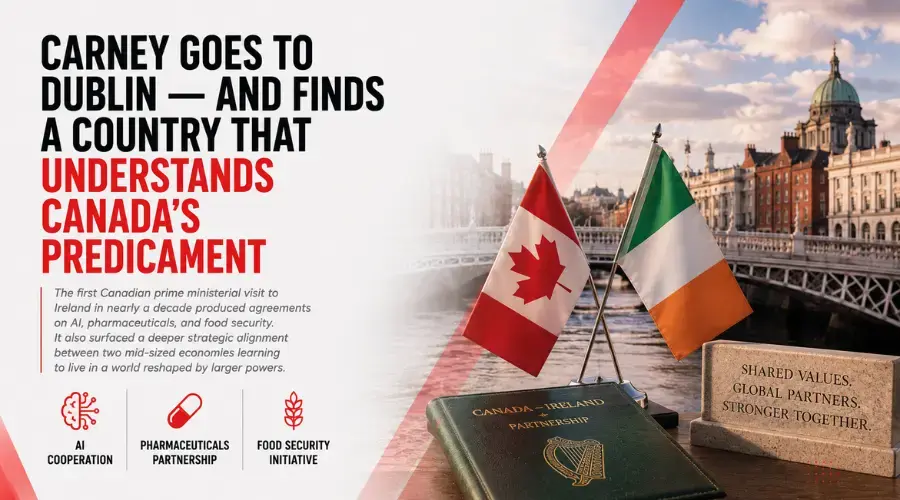
Carney Goes to Dublin — and Finds a Country That Understands Canada's Predicament
The first Canadian prime ministerial visit to Ireland in nearly a decade produced agreements on AI, pharmaceuticals, and food security. It also surfaced a deeper strategic alignment between two mid-sized economies learning to live in a world reshaped by larger powers.
Key Points
- Prime Minister Mark Carney met with Irish Taoiseach Micheal Martin in Dublin on Saturday, June 13, agreeing to deepen cooperation on artificial intelligence, life sciences, and food security.
- The visit is the first by a Canadian prime minister since Justin Trudeau's 2017 trip; it comes as Ireland prepares to assume the rotating presidency of the EU Council in July — a moment of considerable strategic value for Canada.
- Irish exports to Canada have nearly quadrupled in value since the provisional entry into force of the CETA trade deal in 2017; Ireland is now expected to fully ratify the agreement within weeks of Carney's visit.
- Carney will travel Sunday to County Mayo, where his paternal grandparents were born before emigrating to Canada in the early 1920s.
There is a particular kind of diplomatic chemistry that happens when two countries discover they are navigating the same rupture from different angles. Canada is managing its exposure to a United States that has become a less reliable partner. Ireland has spent years managing its exposure to a Britain reshaped by Brexit. Both are mid-sized, open, trade-dependent economies with deep cultural ties to the English-speaking world, strong tech sectors, and a strategic interest in multilateral institutions at precisely the moment those institutions are under pressure. When Prime Minister Mark Carney walked into Government Buildings in Dublin on Saturday morning, he was not visiting a distant ally. He was visiting a country that has already lived through the kind of economic shock Canada is now bracing for.
The agreements announced after Carney's meeting with Taoiseach Micheal Martin were substantive rather than ceremonial. The two leaders committed to aligning their artificial intelligence strategies — Ireland published its AI plan last winter, Canada released its own earlier this month — and expanding collaboration in life sciences, including skills development for students and increased resources for researchers. Carney also announced that Canada would work to open a regenerative medicine hub in Ireland, a move that reflects the depth of the pharmaceutical and biotech relationship between the two countries. Martin described the outcome as a structured and practical road map for a deeper partnership, and said the meeting had confirmed his genuine confidence in the trajectory of the Ireland-Canada relationship.
"Canada, Ireland and Europe are increasingly and immediately vulnerable to once-distant threats. Amidst this disruption, Canada, Ireland and Europe can be pivotal, powerful and purposeful — a force for good."
— Prime Minister Mark Carney, Trinity College Dublin, June 13, 2026The timing of the visit is not incidental. Ireland assumes the rotating presidency of the Council of the European Union in July, giving it unusual convening power across the bloc for the next six months. For Canada, which is actively seeking to deepen economic and security ties with Europe — on defence, energy, critical minerals, and AI — having Ireland in its corner at the precise moment it takes the chair is a significant advantage. Carleton University's Fen Osler Hampson noted that Carney could leverage the visit to encourage Ireland to push other holdout EU member states toward full ratification of the Canada-EU trade agreement, known as CETA. The deal has operated only provisionally since 2017, with ten EU countries yet to complete ratification. Ireland itself is one of them — though Deirdre Giblin, head of the Ireland Canada Business Association, said full ratification is expected within two to three weeks of Carney's departure, as the country's reform of its arbitration law reaches its final stages.
That ratification, when it comes, will matter commercially. Irish exports to Canada have nearly quadrupled in value since CETA came into provisional force, a trajectory that the Conference Board of Canada attributed in a 2024 report to Ireland's growing role as a gateway between Canadian companies and the European single market. Irish tech and financial services companies have been significant beneficiaries; Canadian firms in financial transportation and management consulting have gained access in return. Full ratification would lock in and extend those gains.
There was one item on the Dublin agenda that required more careful handling. The Aughinish Alumina refinery in County Limerick — originally opened by Canada's Alcan, but transferred to Russian ownership in 2007 — has continued supplying alumina to Russian smelters, with investigations ongoing into whether that material is entering military supply chains. The question is politically sensitive: Ireland is officially a neutral country, but has resettled significant numbers of Ukrainian refugees and voiced support for Ukraine. Hampson noted that the Irish government will be reluctant to make any direct criticism of the United States during this period, given its near-total dependence on American foreign direct investment in pharmaceuticals and technology. Carney said he would raise the Aughinish issue with Martin over lunch — a private conversation rather than a press conference statement, which is itself a kind of diplomatic signal.
Carney later appeared at Trinity College Dublin for a discussion on transatlantic ties, where he received a standing ovation upon arrival. His framing of the moment was unambiguous: an era of global disruption in which middle powers must choose to act collectively rather than wait for great powers to restore an order they are themselves dismantling. It is a message Carney has been refining since his Davos speech in January, and Dublin was a receptive audience for it.
On Sunday, the prime minister travels to County Mayo, where his grandfather Robert Carney and grandmother Nora Moran were both born in the town of Aughagower before making their way to Canada in the early 1920s. He will meet with Irish President Catherine Connolly. The visit is personal in a way that few prime ministerial trips are, and it sits at the end of a week that began in Paris with Emmanuel Macron and will conclude at the G7 in Évian-les-Bains. For a prime minister who came to office on a platform of reorienting Canada away from its decades-long dependence on the United States, the itinerary is the argument.