
Germany Wants B.C. Gas. The Ksi Lisims Project Is Starting to Look Like the Answer
Date: 2026-06-09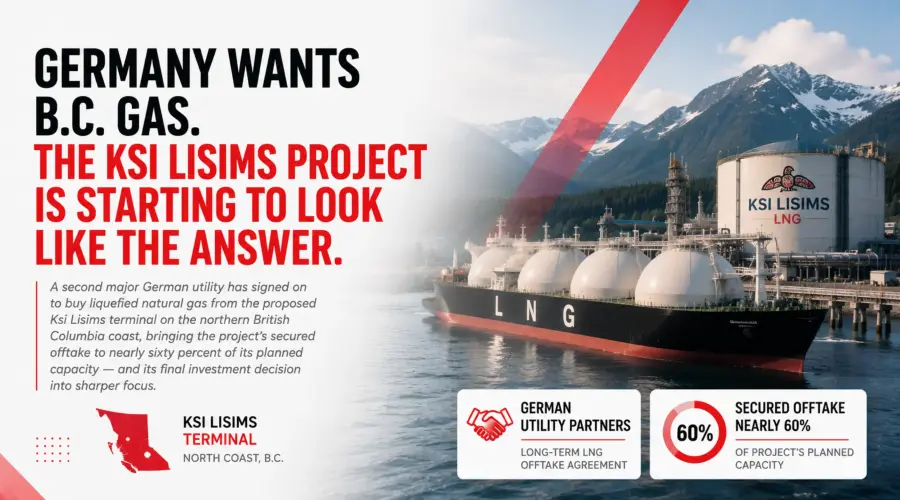
Germany Wants B.C. Gas. The Ksi Lisims Project Is Starting to Look Like the Answer.
A second major German utility has signed on to buy liquefied natural gas from the proposed Ksi Lisims terminal on the northern British Columbia coast, bringing the project's secured offtake to nearly sixty percent of its planned capacity — and its final investment decision into sharper focus.
Key Points
- Düsseldorf-based Uniper has signed a letter of interest to purchase two million tonnes of LNG per year from Ksi Lisims, with deliveries potentially beginning as early as 2032.
- The deal follows a separate agreement signed in late May by SEFE — another German state-linked utility — for one million tonnes annually over up to twenty years.
- Combined with earlier agreements from Shell and TotalEnergies, Ksi Lisims has now secured letters of intent or firm agreements covering roughly seven of its planned twelve million tonnes per year.
- A final investment decision has not yet been made; construction could begin in early 2027 if the partners proceed, with the project carrying environmental approval and national interest designation from the Canadian federal government.
The name Ksi Lisims, pronounced s'lisims, means "from the Nass River" in the language of the Nisga'a people, on whose territory the proposed terminal would sit. It is an apt name for a project that has, over several years of planning and approvals, become something larger than a single industrial facility — a test case for whether Canada can position itself as a reliable, lower-emissions supplier of liquefied natural gas to a Europe still reckoning with the energy convulsions set off by Russia's invasion of Ukraine in 2022. The latest signal that Europe is taking that question seriously came on Monday, when Düsseldorf-based utility Uniper announced it had signed a letter of interest to purchase two million tonnes of LNG per year from Ksi Lisims, with first deliveries potentially starting as early as 2032.
Uniper is not a peripheral player. With 18.5 gigawatts of power generating capacity and a position as one of northwestern Europe's largest LNG importers, it supplies gas markets across Germany, the United Kingdom, Sweden, and the Netherlands. The German government took it over during the acute phase of the 2022 energy crisis, when Russian supply disruptions threatened to destabilise the country's winter heating, and is now in the process of returning it to private ownership. Its decision to look to British Columbia for long-term supply is, in that context, a statement about where European utilities think their energy security will come from over the next two decades.
"Canada offers an attractive environment with significant gas resources, strong political stability and reliable regulatory frameworks."
— Uniper, June 2026What makes Monday's announcement particularly significant is that it is the second German commitment to Ksi Lisims in less than two weeks. On May 27, Securing Energy for Europe — a German government-owned company known by its acronym SEFE — signed a long-term agreement to buy one million tonnes per year from the project over a span of up to twenty years. The two German deals together account for three million tonnes annually. Adding the previously announced agreements with Shell and TotalEnergies, each covering two million tonnes, Ksi Lisims has now committed or near-committed roughly seven of the twelve million tonnes it plans to export each year — approximately 58 per cent of total capacity — without yet having broken ground.
The project's structure is unusual in the Canadian energy landscape and deliberate in its design. Ksi Lisims is a partnership between three co-developers: Houston-based Western LNG, which serves as lead developer and future operator; Rockies LNG, a consortium of Canadian natural gas producers drawing on the Western Canadian Sedimentary Basin; and the Nisga'a Nation, whose ownership of Pearse Island — where the floating terminal would be moored near the Alaska border — gives Indigenous participation a foundational rather than consultative role. Gas would travel approximately 750 kilometres from the Basin to the coast via the Prince Rupert Gas Transmission pipeline.
The environmental and regulatory picture is, by Canadian LNG standards, relatively advanced. Both the terminal and the PRGT pipeline have received key environmental approvals, and the federal government has designated them Projects of National Interest — a classification that signals Ottawa's willingness to support the permitting process. What the project does not yet have is a final investment decision, the formal commitment from co-developers to spend the roughly ten billion dollars required to bring it into operation. That decision, if taken, could allow construction to begin in early 2027.
The broader commercial logic tightening around Ksi Lisims is hard to ignore. Europe's rush to sign long-term supply agreements with non-Russian sources reflects a structural shift in how the continent thinks about energy procurement — away from just-in-time spot purchasing and toward multi-decade contracts that prioritise predictability over price optimisation. British Columbia gas, delivered via floating liquefaction technology and powered in part by the province's hydroelectric grid, is being marketed by Ksi Lisims's developers as producing up to ninety per cent lower greenhouse gas intensity than conventional LNG facilities. That claim will face scrutiny, but for buyers under political pressure to decarbonise even their transition fuels, it is a meaningful differentiator.
The question now is whether the momentum of offtake agreements translates into the final investment decision that would turn renderings into a working terminal. Seven million tonnes per year in committed interest is a substantial commercial foundation. Whether it is enough — and whether the economics, the financing, and the partners' risk appetites align in time — will determine whether Ksi Lisims becomes one of Canada's defining infrastructure projects of the decade, or another well-advanced proposal that stalled at the threshold.