
XRP Drops 4% as On-Chain Data Reveals Worst Realized Loss Spike in Nearly Four Years
Date: 2026-02-22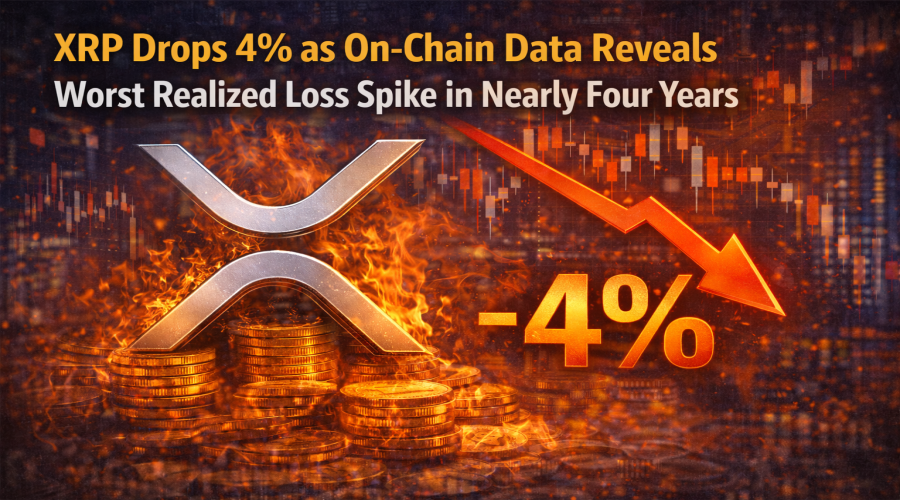
XRP shed roughly 4% this week as on-chain analytics confirmed what many traders had already suspected: the sell-off gripping the token has reached a level of emotional extremity not seen since late 2022. According to data published by Santiment on February 21, weekly realized losses on the XRP network surged to approximately $1.93 billion — the single largest capitulation spike recorded in 39 months.
What Realized Losses Actually Tell Us
Realized losses are not the same as paper losses. They occur when a coin actually changes hands at a price below what the previous holder originally paid. In other words, they measure finalized decisions, not theoretical drawdowns. When that number blows past $1.9 billion in a single week, it means an enormous volume of XRP moved from discouraged holders into new hands — at a discount.
That distinction matters. For realized losses to reach those levels, two things must happen simultaneously: aggressive sellers willing to exit at any cost, and buyers on the other side ready to absorb that supply. The fact that the market didn't simply collapse under the weight of that selling is, itself, a signal worth noting.
The 2022 Parallel
The last time XRP printed a weekly realized loss figure of comparable magnitude was November 2022 — deep in the post-FTX fallout, when the broader crypto market was at its most disoriented. In the eight months that followed, XRP appreciated by 114%.
That precedent has investors watching closely. Historically, extreme capitulation events have tended to cluster near cycle lows. The logic is straightforward: once the weakest hands have been flushed out, the pool of potential sellers shrinks considerably. With fewer motivated sellers remaining, even modest increases in buying interest can shift the trajectory.
Not a Guarantee — But a Meaningful Signal
To be clear, past performance does not pre-determine future outcomes, and the current macro environment carries its own complications. Regulatory narratives around XRP and the broader digital asset space remain in flux, and volatility across major tokens is still running high. The 2022 spike played out in a period of deep, prolonged deleveraging. Today's market is structurally different — spot ETF participation, more developed derivatives markets, and a clearer institutional presence all factor into how liquidity behaves during stress events.
Santiment analysts have noted that fear tends to peak before price actually bottoms. A single large capitulation print does not guarantee a durable reversal; what matters is whether realized losses stabilize in the weeks that follow or quickly re-accelerate. If selling pressure continues to mount, it would suggest distribution is still unfinished. If it fades, the conditions for a recovery start to form.
As of writing, XRP is trading around the $1.41–$1.44 range, having attempted to stabilize after the sharp intraday decline. Whale wallet behavior and exchange outflow data will be key metrics to watch alongside realized loss trends in the near term.
Bottom Line
When nearly $2 billion in XRP changes hands at a loss over the course of a single week, markets tend to be close to an inflection point — not because of any guarantee, but because that kind of selling exhaustion historically precedes the shift from distribution to accumulation. Whether this proves to be that moment will depend on how demand responds over the coming weeks.
For traders looking to capitalize on precisely these kinds of high-volatility setups, having access to sufficient capital is often what separates the ones who catch the move from the ones who watch it. That's why a growing number of active altcoin traders have turned to ATNirex, a crypto prop trading firm that provides funded accounts designed for participants who want meaningful exposure without risking their own capital in turbulent markets.